
Data status: The structure of this page is final. Concrete numbers in the body are waiting to be filled with real data from the project's GitHub repository (README / CHANGELOG / Release / commit). Do not guess values marked
[ To fill ]; measurement data must state its test conditions, and anything that cannot be reproduced should not be stated as a conclusion.
What it does
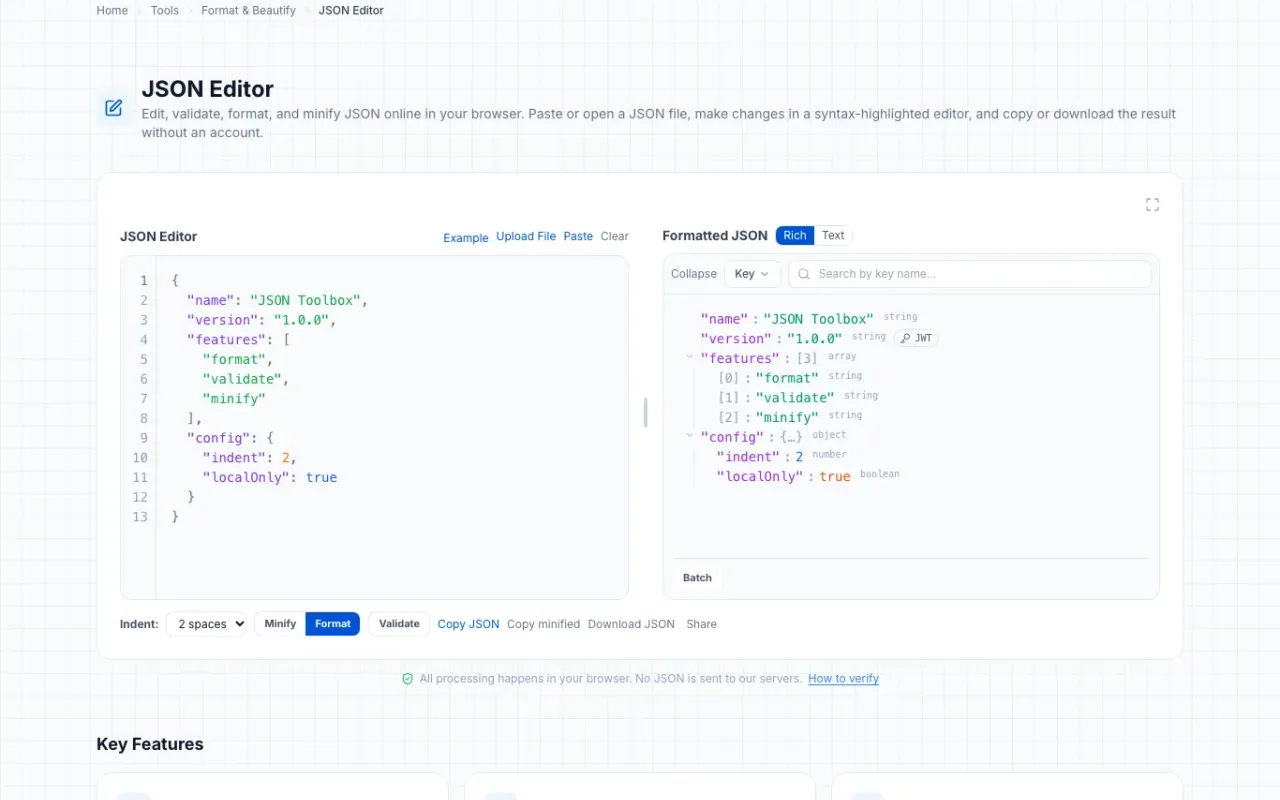
- View and navigate large JSON files with a virtualized tree
- Format, validate, minify and compare JSON
- Convert to/from CSV, YAML, TypeScript and XML
- Test JSONPath expressions against real data
Why I built it
[ To fill: the real problem and target user, from the repo README / commits. E.g. developers need to inspect JSON containing sensitive data, but online tools require uploading the file. ]
How it works
A client-side core; parsing and conversion stay in the browser. The large-file viewer uses virtualized rendering so the DOM only holds visible rows. The same core ships as a website, an embeddable component and a self-hostable build.
[ To fill: concrete architecture, libraries used, privacy model and constraints, based on the source. ]
Results
[ To fill: the metrics below from real GitHub data; measurement-type values must note device / browser / sample / tool / version. ]
| Metric | Value | Source |
|---|---|---|
| Tools shipped | [ To fill ] | GitHub README |
| Client-side processing | [ To fill ] | Architecture fact |
| Large-file first paint | [ To fill ] | Measured (conditions below) |
| Bundle size | [ To fill ] | Build output |
Technical decisions
[ To fill: why virtual scrolling was necessary, and the trade-off. ][ To fill: how malformed JSON and edge cases were handled. ][ To fill: what to improve next. ]
Related build logs
[ To fill: link to the matching build log on this site once published — no empty links. ]